

Pardon Inflation
How Trump's Clemency Spree Is Inflating the Market
Is President Trump’s proclivity to pardon encouraging more aggressive financial risk taking and optimistic modeling and, as a consequence, stock market inflation?
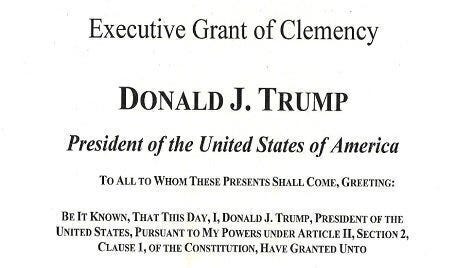
According to this week’s Wall Street Journal, President Trump has repeatedly told top administration officials he would pardon anyone who came within 200 feet of the Oval Office. Former pardon attorney Liz Oyer reported that the pattern is deliberate: the president has telegraphed his intent to use the pardon power to protect those who carry out his agenda faithfully, encouraging more aggresive risk taking in defense of Trump-alligned goals. He has done the same with white collar criminals and business leaders. To name a few:
Trevor Milton, convicted of defrauding Nikola investors — including through a promotional video of a truck that turned out to be rolling downhill.
Changpeng Zhao, billionaire executive pleaded guilty to allowing money-laundering through his cryptocurrency company. He was fined $50 million and served a four-month sentence in a low-security prison and halfway house.
Joe Lewis, a British billionaire who pleaded guilty to insider trading after passing on information about his companies to his private pilots, friends, personal assistants and romantic partners in a fraud that authorities said netted millions of dollars in profit.
Former investment manager David Gentile was pardoned after his conviction for his role in what the Justice Department at the time described as a scheme to defraud more than 10,000 investors by misrepresenting the performance of three private equity funds.
These are not obscure figures. They are financial actors operating in the same markets where your retirement account lives.
Now layer on top of this the administration’s broader regulatory posture. The SEC has been scaled back. The CFPB — created specifically to protect consumers from predatory financial practices — has been effectively dismantled. The enforcement architecture that is supposed to catch bad actors before they become cautionary tales is no longer functionally operational.
Consider the calculus facing a CEO or CFO with an ambitious board, stock price to protect, and president to please. The regulators who would catch you have been neutered. The president who controls the Justice Department has made plain that prosecution is a political act, not a neutral enforcement mechanism. And there is now a visible, documented path — donations, lobbyists, golf, the right words at the right moment — to a presidential pardon if things go wrong.
In my opinion, this is a clear incentive to take risks you otherwise wouldn’t.
I am not suggesting every executive is plotting fraud. But human decision-making operates on margins. Round up or round down? Present the optimistic revenue projection or the conservative one? Disclose the risk factor prominently or bury it on page 47? These judgment calls happen constantly, governed by a combination of legal exposure and professional norms. When you reduce legal exposure and surround yourself with peers who have watched fraud convictions disappear with a phone call, the calculus shifts. Not for everyone. But for enough people, on enough close calls, to matter. Fraud doesn't always require a bad actor — sometimes it just requires a bad climate, one where the rules are bendable and the consequences are negotiable. ("Bringing Freud to Fraud: Understanding the State-of-Mind of the C-Suite Offender," University of Dayton eCommons)
History doesn’t require us to speculate. Enron’s executives didn’t begin with a master plan. They started with aggressive-but-defensible accounting, watched each decision go unchallenged, and moved further out on the limb. Madoff reportedly began by covering small losses he was confident he could recoup. The fraud industrialized. The numbers grew. The reckoning, when it came, was catastrophic for everyone who had trusted the reported numbers.
“Well, you know what happens is, it starts out with you taking a little bit, maybe a few hundred, a few thousand…You get comfortable with that, and before you know it, it snowballs into something big.” - Bernie Madoff
The difference now is that the reckoning itself is in question. When the president casually pardons fraud convictions— the threat that historically kept aggressive-but-legal actors from crossing into clearly-illegal territory has been materially weakened.
Markets are pricing mechanisms. They aggregate information about a company’s future earnings and discount it to a present value. That process depends on the information being accurate. When the incentive structure shifts in ways that make financial misrepresentation more attractive and less risky, markets don’t immediately crash. They inflate. Numbers look better than they are. Risk is hidden rather than disclosed. Prices rise. Everyone feels confident.
And then reality asserts itself. It always does.